
We’ve been quiet lately. We’ll make some noise soon.
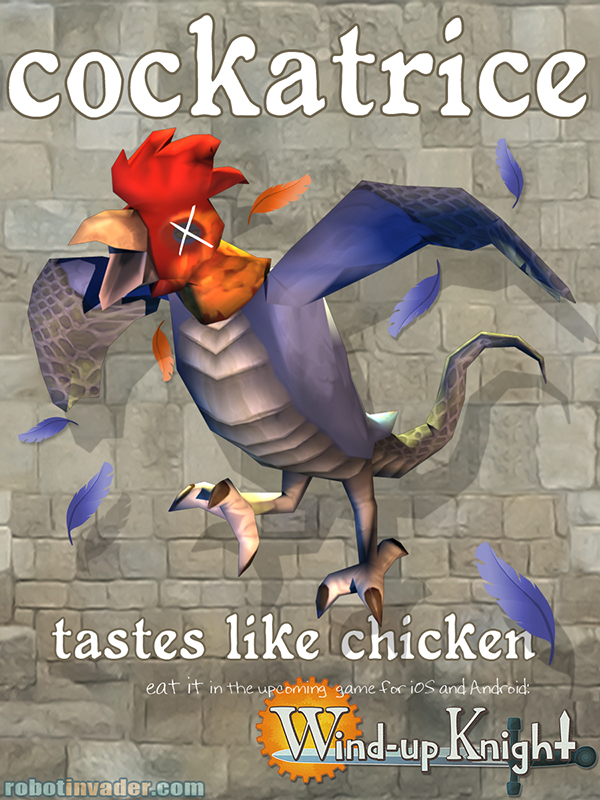
Baw-baaaawk!!
We’ve been quiet lately. We’ll make some noise soon.
Baw-baaaawk!!
We know you’ve been biting your nails with anticipation for Wind-up Knight, so much so that you’ve started to eat into the fleshy bits at the tips of your fingers. Fortunately, we have a way for you to avoid all-out epidermal disaster: come play Wind-up Knight at Tokyo Game Show next week!
A fully playable and absolutely ego-destroying sample version of Wind-up Knight will be on display at SonyEricsson’s booth–just look for the large Xperia Play demo station. Wind-up Knight will be ready and waiting to put you in your place on any of SonyEricsson’s vast array of demo devices. Make that incredibly long trip to Makuhari Messe worth the trouble by playing our awesome game!
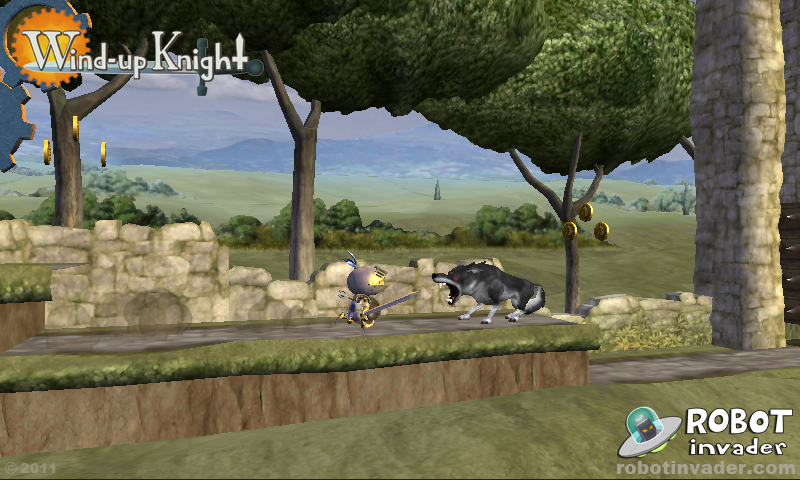
To whet your appetite here’s a new screenshot of a player about to get served by a goddamn wolf.
Robot Invader初のゲームの日本版を遂に発表しました。難しさが半端ない「ねじ巻きナイト」は今年の秋にアンドロイドとiOSに登場します。東京ゲームショーに行かれる方は、是非ソニー・エリクソンのブースのXperia Playでデモ版を試してみてください。難しくてハマりやすいゲームですので、現場で遊びすぎないようにご注意願います。よろしくお願いいたします!
We are absolutely, positively, fantastically excited to announce Robot Invader’s first game: Wind-up Knight, coming this fall to Android and iOS.
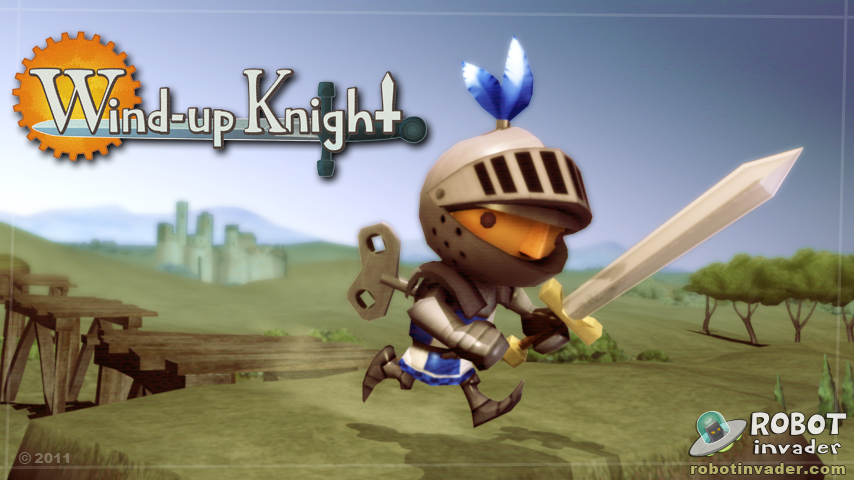
Wind-up Knight is a game designed to test your mettle.
We know you enjoy screwing around on your phone when you have an extra five minutes to kill. There are plenty of games out there that are slightly less boring than shuffling your feet or trying to read the eight month old sports magazine at your dentist’s office. Sure, maybe they are not great games, but hey, it beats staring off into space.
Wind-up Knight is different. It’s a platformer, sort of. It’s a timing challenge, sort of. One thing’s for sure, it’s designed to test you. Test your gaming prowess. We’re talking design with no remorse, diabolically difficult levels that will keep you up at night. You know how to play games, you don’t need any hand-holding. Checkpoints are for wimps. Power-ups are for wimps. Wind-up Knight is about being totally awesome in the face of insidiously challenging stages.
Oh, and did we mention that it has some of the best art and graphics that you’ve ever seen on your phone or tablet? You spent some serious dough on that thing and now it’s time to put that fancy mobile technology to work.
Sure, you could play this game for five minutes at a time. But we think you’ll play for longer than that, a lot longer; brief respite will come only when your phone’s battery dies. Because after you school one level, there’s another waiting to up the ante just a little bit more. Look, the dentist can wait. This is Serious Business. This is Wind-up Knight.
Lots more information is coming soon. Watch this space. In the meantime, check out the screenshots below.
 You're about to get chopped, chicken! |
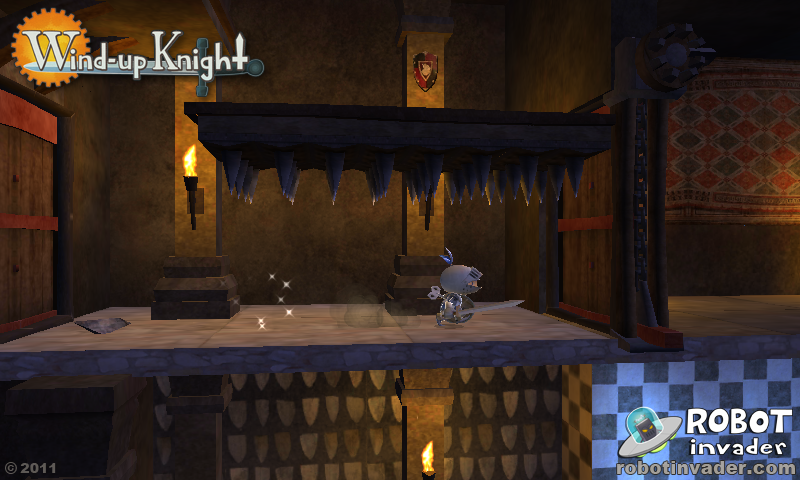 Caution: Low Clearance |
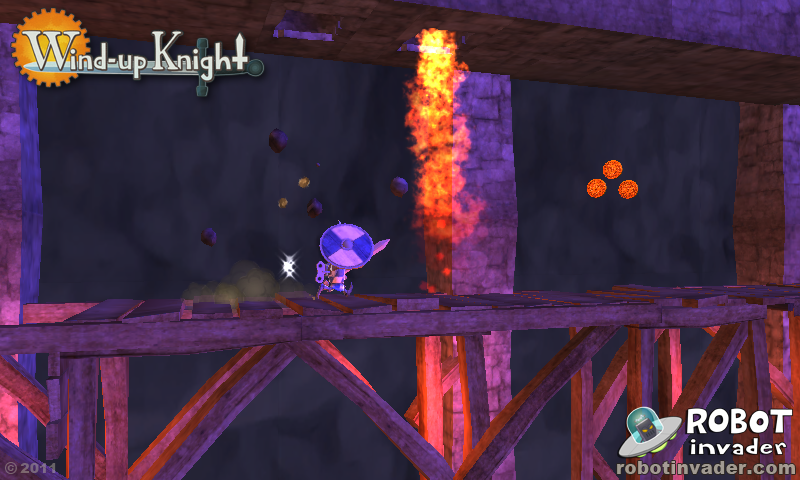 Keep that shield up! |
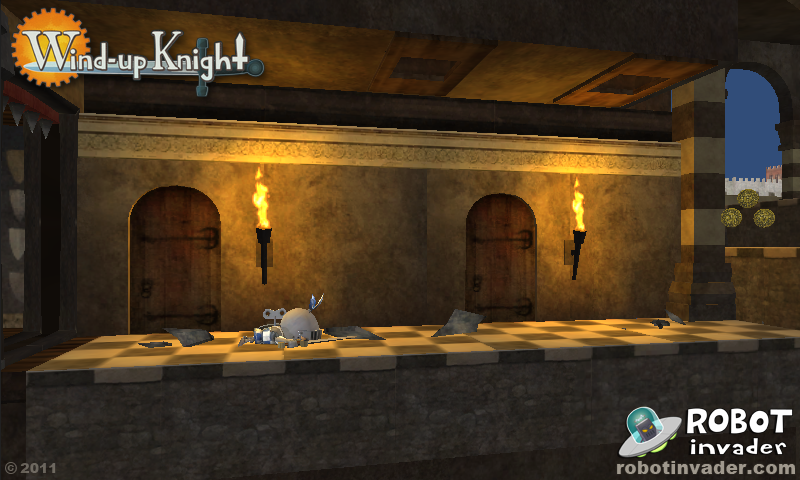 Oof! |
 Through the Fire and the Flames |
Robot Invader is housed in a small office in Mountain View, California. The office is located in one of the many featureless business parks that pepper the Peninsula like the aftermath of a boring meteor storm, a rectangular wedge of gray protruding from the landscape. Personally, I would have preferred some sort of Victorian mansion, not unlike those that dominate the Resident Evil games, complete with a secret underground laboratory for nefarious experiments. Alas, ours is a utilitarian structure; the architects of our building chose not waste much space on impressive staircases or hedge mazes.
But had we access to long passages with marble flooring and spot lighting, we would use the location to hang portraits of our heroes. Such a hall would be adorned with images of Suda51, Jordan Mechner, and Hideo Kojima. Akira Yamaoka, Eric Chahi, and Daisuke “Pixel” Amaya. Jason Jones, SWERY, and Team Meat (in their matching sweaters) would all have a place. While we’re big fans of all sorts of game development studios all over the world, these individuals are particularly influential to us because their personalities shine through the games that they make. Even when they miss the mark, these developers build games that have charm, vision, and a unique internal consistency. Their work pulls you off your couch, through your TV, and into their head, much like Raz’ brow doorway in Psychonauts. If we could, we’d put portraits of these people up to remind us that a big part of artistry is the artist himself.
There are designers throughout the game industry with the capacity to fuse their games with distinct personality, but many of them never get the chance. Game development is a complicated and risky endeavor; modern game teams are often constructed to mitigate risk by any means necessary. Rather than give any one person complete creative control, many studios attempt to stabilize development by distributing creative responsibility across many different disciplines. There are art directors, combat directors, game play programmers, producers, and all sorts of other stakeholders that have a say in the development process. If a lead designer wants some feature but the lead engineer says it probably costs more than it is worth, the safe thing to do is to kill it. When polish and schedule are your primary concerns, this is a valid method to ensuring that your studio can maintain quality without veering too far from the original plan.
The problem is, this method produces games that, despite sporting high production values and general slickness, have no personality. They are the game equivalent of our drab office park, built for maximal efficiency and minimal risk. Such safe games are not bad games per se, they are just, well, routine. Don’t rock the boat. An 80 on Metacritic requires a specific set of high-level features, so let’s make sure we have those first. A bad game shipped is better than no game shipped. Let’s cut the hedge maze and use that space for more cubical storage.
Not to say that these studios would be better off throwing caution into the wind and just developing willy-nilly with no process at all, like some hedonistic commune or something. Putting your faith in one person to direct all aspects of game development is a hard thing to do, both for the folks running game development studios and the rest of the team working under that person. Design is a creative process, and it can be messy; it’s the polar opposite of the “well oiled production machine” that many studios aspire to become. And sometimes the results are mixed; Deadly Premonition is one of the most interesting games I’ve played and yet it’s an extremely rough game, production-wise. I’m a big fan of No More Heroes and Killer7, but Suda51’s earlier Michigan is terrible. Still, nobody else in the world could have made Killer7. Deadly Premonition wouldn’t exist without SWERY. Resting an entire game on the shoulders of one person is dangerous, but when it works out the personal touch of the designer improves the game dramatically.
So taken are we with the power of an individual to completely influence a game design that we’ve attempted to create a process to support it here at Robot Invader. While all of us have titles related to our discipline and roles, there is one title that trumps us all: the Game Director. For each game we make we select a single person to act as Director. This person is the authority of the design, the vision holder, and most importantly, the tie breaker. He may be an engineer, a level designer, an animator, whatever. The Game Director may not design the entire game from top to bottom, but he or she has the power to overrule any design decision. He has the power to change the schedule to accommodate a new idea, or to scrap work that has already been completed. The Game Director takes the game we are making and fuses it with a consistent, singular vision. If he wants to make a Victorian mansion instead of an office park, that’s what we’ll make.
With a Game Director in place there are no stalemates. We trust in our ability to implement just about any idea, and look to the Director for final say in what that idea actually is. We all participate in design, of course; as a small studio we can actually benefit from hard-core collaboration without veering off the road into the Ravine of Kitchens With Too Many Cooks. But every concept, every implementation, every UI screen passes through the Director, and is often mutated by him in transit. The resulting work is still a collaborative effort, but it’s one that has been uniquely shaped and molded by the Director in charge.
We think that the resulting games will feel different and unique. The Game Director responsibility rotates with each project, so our games should also have their own distinct flavor. In a market dominated by knock-off products and outright clones, we think that the influence of a singular Game Director will give our titles the creative edge, which will translate directly into sales. Then we can get that secret laboratory installed.
If there are any universal rules or golden constants by which the game industry is governed, one of them is surely this: never count Nintendo out. It is not an exaggeration to call the Kyoto firm the world leader in video game production. They have sold more video game hardware than anybody else (Nintendo dominates the top-selling console list; the DS is the best selling game system of all time), their software is among the best in the industry (Metacritic suggests that the only game superior to Super Mario Galaxy 1 and 2 is GTA 4), and they are one of the few giants in this industry that is willing to take risks. Nintendo does occasionally stumble; their attempts at digital distribution and online games have, thus far, been infantile compared to Microsoft and even Sony, and they can’t be happy about dropping the price of the 3DS by $80 only a few months after launch. Their WiiU announcement earlier this year was met with a lot of head scratching, and they recently reported their first quarterly loss since 2004.
But whatever you do, never, ever count Nintendo out.
Nintendo can’t be ignored because they are fundamentally different than the other large game industry companies. They take risks no other company would take, from the PowerPad to the original GameBoy to the Virtual Boy to the DS, Wii and now WiiU. Sometimes these experiments fail, but mostly they do not. When Satoru Iwata announced Nintendogs and Brain Age, two games that resemble nothing else in the industry and are arguably not even games, the incredulity felt by the developer community was palpable. Many developers had a good chuckle over Nintendo’s utter cluelessness. Nintendogs and Brain Age went on to sell over 20 million units apiece, putting them both in the top 20 best selling games of all time (a list which, by the way, contains only one non-Nintendo title, GTA: San Andreas). To put that in perspective, Brain Age has been sold more times since 2006 than The Grapes of Wrath since its first publication in 1937. Hell, even Brain Age 2 outsold old Steinbeck.
The key difference between Nintendo and Sony or Microsoft is that they build hardware around their games, rather than the other way around. This approach often results in hardware that is hard to pin down at first. People had no idea what to do with the DS’ two screens until Nintendo showed them; they had no clue how motion control was going to work until Wii Sports proved it. Right now I’m sure people are struggling to understand the benefit of the weirdo controller that is the main selling point of the WiiU, but I’m confident that it’s a design that was prompted by the needs of a game.
Nintendo is best when they do this sort of crazy risk-taking. Sony and Microsoft sure aren’t going to do it. Nintendo falters when they do not take enough risk; the Nintendo 64 suffered from their decision to stick with cartage-based media, the GameCube was too conservative, and the Virtual Boy was just a bad product. The problem with the 3DS is that it’s only an incremental improvement over the DS, and so far there hasn’t really been any of that compelling first-party content to back it up. I think we’ll see what happens to that console this Christmas; all it really takes is a few great games to give the rest of the industry confidence in the platform.
So it is unwise to bet against Nintendo. This year hasn’t been great for them, but to count them out now would be a very foolish mistake.
That said, here at Robot Invader we are not interested in developing for Nintendo platforms, at least not at the moment. Nor, for that matter, are we interested in Sony or Microsoft consoles. We believe that the era of traditional consoles is coming to a close.
I recently wrote an article about how the Sony Ericsson Xperia PLAY has the potential to change the game industry. It’s a long article, but the point is this: when phones are as fast as consoles, the only reason to keep a console around is for the buttons on the controller. If phones with buttons like the PLAY succeed, I think the market for consoles will vanish. It will be increasingly difficult for console manufactures to differentiate themselves from your average smartphone as the quality of smartphones improves, and it’s improving at a breakneck pace. Nintendo wasn’t even able to be first to market with a 3D screen for the 3DS; an Android phone in Japan with a similar screen shipped a few months before the 3DS launch. I look at the Playstation Vita and I see hardware that will be in phones extremely soon, perhaps even before the Vita itself launches. The business model for consoles for the last few decades has been about selling hardware that could be stretched out over a multi-year lifespan, and in the face of rapidly improving phone and tablet technology that model is no longer viable.
We’re in the middle of a transitional moment where the console makers must struggle to remain relevant. The internet is like a plague of locusts, spreading over traditional business models and eating them alive, and if consoles do not change they too will fall. Iwata has talked about “preserving the value” of video games (by which he means the existing pricing structure), but I don’t think value is something that any single company is able to control. Once there’s a market for similar content at much lower cost, traditional $40 – $60 games start to look pretty expensive. How can any hardware company compete with a platform that does more and has more content for less?
One solution might be to try to adapt existing technologies to weather this storm; I think Microsoft is headed in this direction with their Xbox Live integration in Windows Phone 7. Another approach might be to stick it out and hope for the best; this seems to be Sony’s idea with the Vita (though, large company as they are, they are also part of the swarm with their various Android devices).
The question in my mind is this: how will Nintendo respond?
Of the three console makers I think the big N is the best positioned to survive this transition. Their hardware is unique and can succeed without being the most technically brilliant box on the shelf. Their (game) software is amazing, and their brand power is unbeatable. But as a company with a lot of pride, I am sure that Nintendo is not content to simply develop for somebody else’s device. Guessing what Nintendo will do next is always tough, but whatever they decide to do will help shape the future of game development.
Make no mistake: Nintendo isn’t down for the count. In fact, if there’s one company to keep an eye on as the game industry shifts to new types of platforms, it’s Nintendo. Developing for consoles doesn’t make any sense for a studio like Robot Invader right now, but who knows which companies will stand out in the post-console world? I bet the big N does alright.
For the past several weeks we’ve been prototyping different ideas for a new mobile game. Taking the time to “find the fun” through experimental prototyping is one of those Game Development 101 strategies that everybody agrees is a good idea and yet few teams actually have the leeway to implement. Very often the schedule is written to assume the game will be fun after a few tests and therefore the team can move into production quickly. Instead, what happens too frequently is that the arbitrary schedule forces teams to switch gears before the core bits of fun have been identified, thus complicating the production process (which isn’t really production but just a more expensive extension of prototyping) and sometimes damning the game to mediocrity.
At Robot Invader our development process is driven by a simple mantra: never compromise on quality. If we can’t execute the idea we have at the quality we require, we will simplify it or cut it. There’s almost never a good reason to ship something that is half-assed.
So, with our quality-focused mantra in one hand and our sense of enlightened professionalism in the other, we optimistically dove into prototyping our new game idea. The initial concept for the game looked good on paper, but, as we should have anticipated, actually implementing the damn thing revealed a lot of flaws. First and foremost, our design called for the user to touch objects in the environment as a character moves through the scene. As soon as we knocked together a basic prototype of this mechanic, the core idea upon which we intended to rest the entire game, we found it was basically unplayable: the moving character required a moving camera, and manipulating moving objects on the screen, even when they move slowly, is difficult and frustrating.
Cue doubt and apprehension. Our sense of enlightened professionalism called in sick that week. We had an idea, and we made it, and guess what? It wasn’t good enough. Our mantra for quality requires us to change it or throw it out, so we did.
With a couple of changes we had something playable. We locked the camera in place, changed the level design to use one screen worth of real estate, and shuffled the other components of our initial concept around until it worked. And actually, it worked pretty well. Within a few days we had a bunch of levels, each with different mechanics, each of which might make their way into a final game. It was encouraging progress because we were able to make levels that were extremely difficult without being arbitrary or unfair. I think the mark of a good game design is one that can scale up in difficulty without relying on changes to the core rule set, and with our tweaks this design certainly stood up to that test.
At first we felt good. We were back on track with a few minor edits to the original formula. But as we worked forward with the prototyping, our excitement waned. The design was solid, and we could make a whole game out of it. And it would be a fun, if somewhat quaint puzzle game. But it wasn’t going to be a big breakout success. It was a little underwhelming.
As we started to prototype the art pipeline we realized that we’d made a trade-off without even realizing it. By simplifying our game concept to work around flaws in the original design we’d cut the teeth out of our art. With a static camera the scenes that Mike was building became flat and boring. There’s nothing wrong with 2D games, but we have a specific style in mind that doesn’t work well with a flat perspective. Though it would be wrong to make the game design subservient to art requirements, trading art quality for design hacks is also not acceptable. It’s a compromise, and quality is the loser. A better game design would work in tandem with the art, not against it.
So we changed gears again. Went back to the drawing board, resurrected some ideas that had landed on the cutting room floor during our previous experiments. And this time, it’s clicked. The design was easy to prototype and is more fun to play after only a day or two of work than our previous attempts. It works with the art style, and in fact has opened up many avenues that we didn’t previously consider. The camera is moving, the interface is simple, and it’s able to draw upon game design precedent without losing its personality.
There are still many questions we haven’t answered. Our experimental prototyping work will continue until we can show how the design will scale across an entire game. It’s possible that we’ll find some flaw in this new approach, but I don’t think it’s likely. The white-box prototypes are fun, there’s a great deal of flexibility inherent in the idea, and it’s going to look awesome. We’re excited again, and glad we didn’t settle for a mediocre idea. Making the game as good as it can possibly be will require our noses to become intimately familiar with the company grindstone, but the path forward is clear.
Of course, when we have more to share you’ll hear about it here first.
What separates the mobile gaming experience from the console gaming experience? I don’t mean obvious differences, like the size of the screen or the control interface, though those are important. I’m also not talking about the on-the-go nature of many mobile games, nor the huge price difference between retail games and those distributed digitally. These are legitimate differences that certainly influence the play experience, but they are differences intrinsic to these two platforms. What I’m talking about is the game content itself.
What are the core components of a good game?
Are those components the same across mobile and console platforms?
I contend that the main goal of any game on any platform is to be interesting. Boring is the opposite of interesting, and boring games have little value. An interesting game has good mechanics, layered and intricate content, or sometimes both. There’s some reason for the player to return to it over and over; something about the experience represents a problem worth solving, or a story worth finishing. The princess is in another castle, one unlike those we’ve seen so far. In playing we will be forced to think, to strategize, to learn. This is the essence of fun.
The problem is many games, in fact most games, fail to pull this off. On the console side of the universe development costs are so high and the audience so narrow that experimentation is very difficult. The genres are well defined but the best games are those that explore uncharted game design territory. Unfortunately, deviation from the precedent is a luxury that few console developers believe that they can afford. Emphasis is instead placed on areas of development that are considered “safe bets”–better graphics technology, brand licensing, and sequels.
On the mobile side, experimentation abounds but many titles lack depth. So many mobile games are simply an exploration of a single mechanic. A great mechanic can carry a game for a while, but eventually it becomes routine. If there’s no other content to keep the player interested he’ll eventually move on to something else. And if the mechanic isn’t so great to begin with he may drop the game immediately.
We are console game developers. Between us, we’ve shipped over two dozen games for various traditional platforms. We believe that while the interface, audience, and economics of mobile games is different, the core components of quality are the same.
At Robot Invader we bring console development techniques to mobile platforms to build fascinating games. We are interested in the space between Minesweeper and Gears of War. Games that grab the player and pull him in with interesting content and story but can still be played on the go using simple, expressive mechanics. Games that stay with you after the phone is turned off. Games that invade your dreams.
Shenmue II is possibly the best game ever.

Chris Pruett
Chief Taskmaster
Damn, son.

Casey Richardson
Creative Director
Hey you Kids! It's not really my quote but I find myself saying it a lot.

Mike Witt
Art Director
...

Jonny Russell
Designasaur
My Trans Am has a GUN RACK. It's so awesome, I don't even need any guns.

Nicholai Lamberstat
Marketing Master